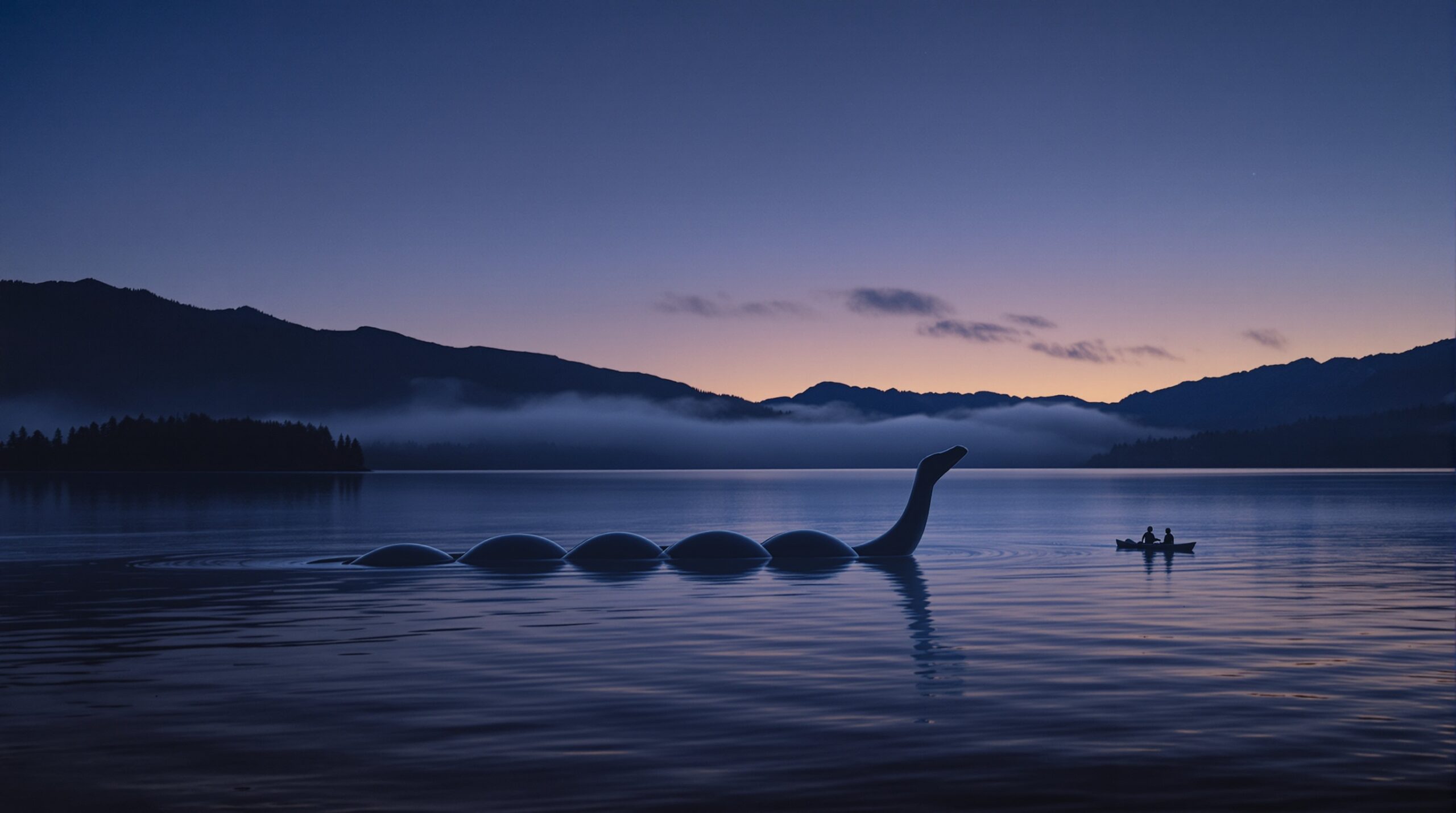
Ogopogo: The Unfinished Story of Canada’s Most Elusive Lake Monster
Okanagan Lake sits long and deep under a sky that shifts from dazzling summer blue to a ghostly winter grey. For centuries people on its shores have told the same kind of story: something large moves beneath its surface. That something has a modern name — Ogopogo — and a tangled mixture of legend, eyewitness testimony, tourism, and scientific curiosity surrounds it.
From First Nations legend to modern myth
Long before newspapers printed sensational accounts, Indigenous peoples of the Okanagan Valley told stories of a powerful water-being. Names vary among nations; N'ha-a-itk and Naitaka are among the traditional names used to describe a great spirit or water guardian associated with the lake. These stories are complex — part mythology, part law, and part cosmology — and they traditionally carried warnings about respect for the lake and what lies beneath.
In the late 19th and early 20th centuries, non‑Indigenous settlers and newspapers began retelling sightings in sensational terms. By the 1920s the nickname “Ogopogo” took hold in popular culture and tourism: a catchy, marketable creature that has since become a regional emblem.
What people report seeing
Sightings describe a range of shapes and behaviors, but common themes recur:
- A long, serpentine humplike form riding the surface.
- Multiple humps in a line, often interpreted as vertebrae.
- A single large dark head and neck rising from the water.
- Rapid surface wakes or long, slow undulations.
Eyewitness accounts vary widely in reliability, from sober first‑hand testimonial by long‑time locals to dramatic late‑night claims that are difficult to verify. Photographs and film exist, but none has provided incontrovertible proof; many images are ambiguous or later identified as log wakes, boat wakes, groups of otters, or simply optical illusions.
Science and skeptics: what might Ogopogo really be?
Several natural explanations account for many sightings:
- Misidentified animals: groups of river otters, seals (rare but occasionally reported), or large fish creating wakes.
- Floating logs, kelp mats, or debris moved by currents and wind.
- Wave patterns and optical illusions caused by light, reflections, or the observer’s vantage point.
- Boat wakes or wakes reflected by the shoreline that appear organic.
Scientific searches — sonar sweeps, underwater camera attempts, and systematic surveys — have not produced confirmed evidence of a large unknown creature. That doesn’t end the conversation: large, deep lakes are complex ecosystems, and rare or transient phenomena can be hard to capture.
The cultural and economic story
Ogopogo is not only a mystery; it’s a cultural symbol and economic driver for the Okanagan. The creature appears on souvenirs, is the centerpiece of local festivals, and anchors tourism campaigns. A life‑sized statue near the lake and guided Ogopogo boat tours are popular draws.
At the same time, Indigenous communities emphasize the original stories and their meanings — cautionary tales about respect for the lake and natural law — and they sometimes critique how the legend has been commercialized without always representing their voice.
If you want to investigate — practical advice
Looking for something unusual on a large lake is exciting, but rigorous documentation turns a fleeting sighting into useful evidence. If you see something:
- Record exact time, date, and location (GPS coordinates if possible).
- Note weather, wind direction, wave height, and visibility.
- Take multiple photos and video from different angles. Hold your camera steady and keep it running — the best evidence is motion footage.
- Note the size and distance relative to known objects (boats, buoys, trees) and estimate scale.
- Ask nearby witnesses if they saw it, and record their accounts.
- If you have access to a depth finder or sonar, log any odd returns and their depth readings.
Be safe: don’t approach fast-moving wakes at speed, and respect private property and Indigenous cultural sites.
Conservation and a bigger context
Whether or not a large unknown animal lives in Okanagan Lake, the lake itself faces real, provable threats: water quality issues, shoreline development, invasive species, and habitat changes. Protecting Okanagan Lake benefits everyone — fishermen, swimmers, boaters, and yes, the storytellers who still scan its surface for something extraordinary.
Viewing the Ogopogo story through a conservation lens reframes the legend: it can be a reason to care for the lake rather than solely a tourism mascot.
Why the story endures
Ogopogo persists because it combines mystery, regional identity, and the human love of the unknown. Stories fill the gaps where evidence is thin. They connect generations: Indigenous myths, pioneer tales, and modern eyewitness accounts form a continuous, evolving narrative.
Maybe one day a clear, unambiguous photograph or biological sample will settle the question. Or maybe Ogopogo will remain a living legend — part natural history, part communal story — and one of the things that makes Okanagan Lake feel a little less ordinary.
Where to learn more
- Visit local museums and cultural centers in the Okanagan for historical records and Indigenous perspectives.
- Check regional ecology reports for the latest on Okanagan Lake conservation.
- If you enjoy folklore, look for oral‑history collections and ethnographic work on Naitaka/N'ha‑a‑itk.
Whether you come for the landscape, the lore, or the chance to spot something inexplicable, Ogopogo is a reminder that some places keep a bit of mystery in reserve. And sometimes that mystery is reason enough to pay attention — and to protect the waters that hold it.